

- Metabolic engineering of Escherichia coli for the biosynthesis of nylon 6 and nylon 6,6 monomers
- 관리자 |
- 2026-06-01 10:43:57|
- 69
- 2026-06-01 10:43:57|
ㅇ [Title] Metabolic engineering of Escherichia coli for the biosynthesis of nylon 6 and nylon 6,6 monomers
ㅇ [Journal] Proceedings of the National Academy of Sciences of the United States of America (PNAS)
ㅇ [Author] Da-Hee Ahn, Tong Un Chae, Sang Yup Lee*
ㅇ [Abstrct]
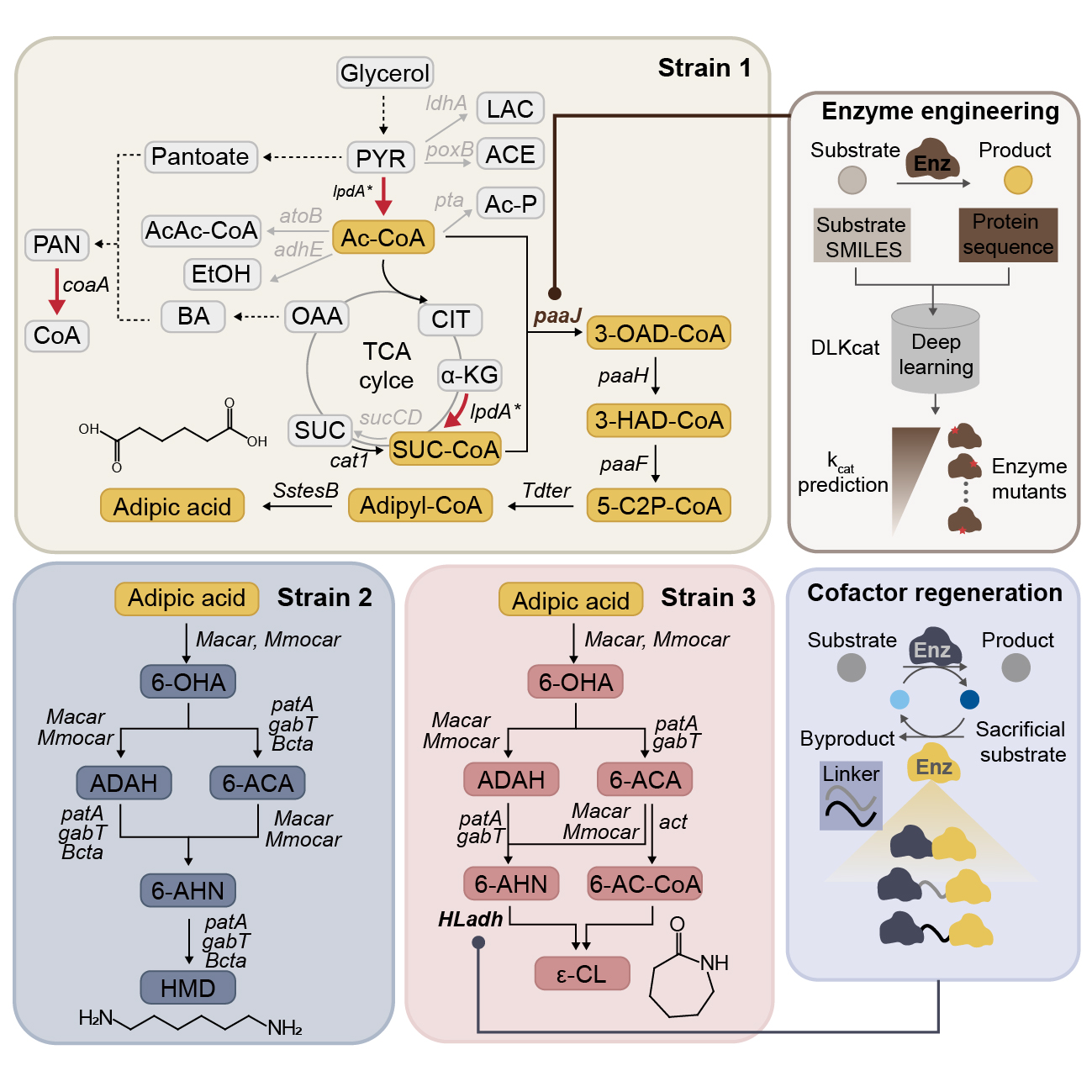
Hexamethylenediamine (HMD), adipic acid, and ε-caprolactam (ε-CL) are essential C6 monomers used in the production of nylon 6,6 and nylon 6. Developing sustainable,
bio-based routes to these compounds remains challenging due to pathway complexity. Here, we report a modular Escherichia coli platform for the de novo biosynthesis
of all three monomers directly from glycerol. We divided the overall pathway into upstream and downstream modules, with the upstream module converting glycerol to
adipic acid. To construct downstream module, two distinct strains were engineered to individually convert adipic acid into HMD or ε-CL. Both strains employed carboxylic
acid reductases Macar from Mycobacteroides abscessus and Mmocar from Mycolicibacterium moriokaense, with the latter identified and validated in this work.
Specifically, HMD biosynthesis incorporated aminotransferases PatA from E. coli, GabT from Streptomyces avermitilis, and the newly introduced Bcta from Burkholderia
cenocepacia. ε-CL biosynthesis utilized a similar upstream pathway but relied critically on a lactamization step catalyzed by an HLadh–Smnox fusion enzyme containing a
flexible linker for efficient NAD+ regeneration. The common precursor, adipic acid, was produced by an upstream strain optimized through reverse β-oxidation (r-BOX)
pathway reconstruction, PaaJ engineering, and metabolic flux balancing, achieving a titer of 6.1 g/L. In fed-batch fermentation, co-cultivation of the engineered strains
with delayed inoculation enabled temporally coordinated conversion of glycerol to HMD (230.9 mg/L) and ε-CL (808.0 µg/L), representing low yet the highest titers
reported to date. This work opens up the possibility of a unified, modular microbial platform for the sustainable production of nylon monomers from a renewable carbon
source.
| 첨부파일 |
|
|---|